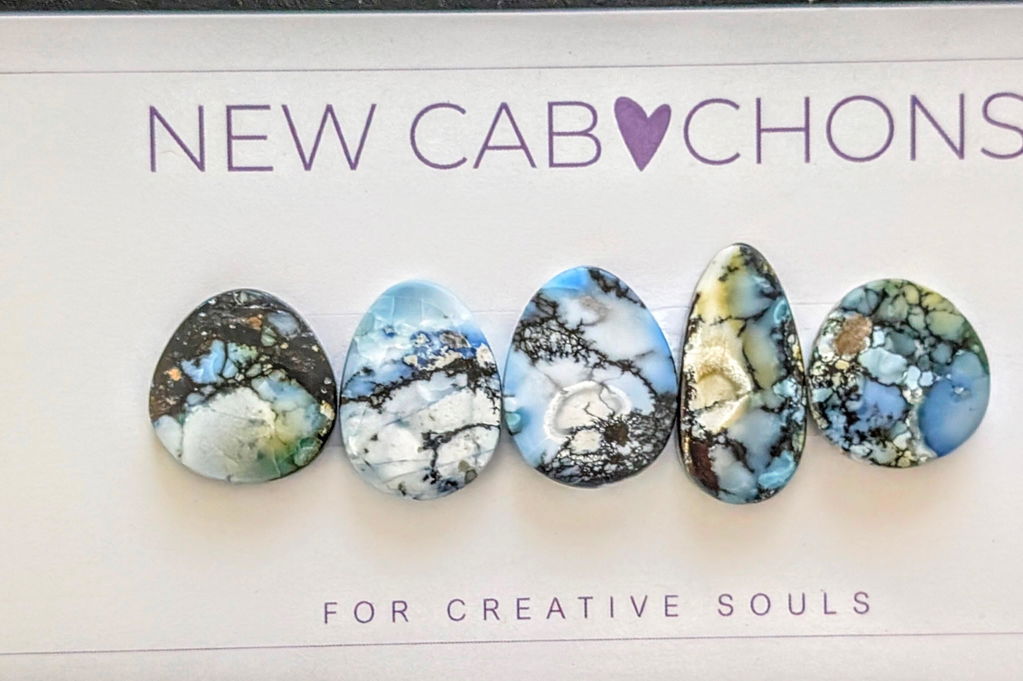
Mexican Turquoise Cheatsheet for Jewelry Makers | New Stone Age Cabochons
TLDR: Mexican turquoise is a copper-based gemstone beloved for its vivid blue-green tones and natural metallic pyrite inclusions. Unlike American turquoise which features rock matrix, Mexican turquoise features distinct shiny gold-colored flecks of iron sulfide (pyrite). It is a favorite among silversmiths for its mixed-metal aesthetic and affordable durability.
Download your printable Mexican Turquoise Maker Guide and keep all key tips at hand. Now keep reading to learn how to use this beauty in your next creation
Quick Facts
| Property | Value |
|---|---|
| Scientific name | Hydrated copper aluminum phosphate |
| Common names & varieties | Mexican turquoise, Campitos, Nacozari, Sonoran Blue |
| Mohs hardness | 5–6 |
| Typical sizes | 5–10 mm cabochons |
| Colors | Bright aqua, ice blue, deep green |
| Distinct feature | Natural pyrite inclusions |
| Origins | Cananea & Nacozari, Sonora and Northern Mexico |
| Price band | $10–70 |
| Best uses | Pendants, rings, statement jewelry |

|
 |
 |
What Makes Mexican Turquoise Unique?
While most turquoise has a rocky brown or black matrix (host rock), Mexican turquoise from the Campitos mine is unique because it forms within copper deposits rich in iron. This results in pyrite inclusions, which appear as gold-colored flecks or veins that look like gold or silver glitter suspended inside the blue stone.
Rather than diminishing value, pyrite adds contrast and uniqueness, making each cabochon a miniature geological artwork story.
Are Pyrite Inclusions Natural in Turquoise?
Yes. Pyrite inclusions occur naturally during the stone’s formation and are not a treatment or enhancement. In Mexican turquoise, pyrite is especially prized because it creates a striking visual interplay between metallic gold and vibrant blue-green tones.
Is Mexican Turquoise Durable for Jewelry Making?
With a Mohs hardness of 5–6, Mexican turquoise is suitable for jewelry when set thoughtfully. Pyrite inclusions can actually add structural stability compared to softer, chalky turquoise.
Maker Note: Pyrite (Mohs ~6.5) is harder than turquoise. When polishing or setting, the stone is generally stable, but be aware that the pyrite spots are dense and metallic.
Best uses include:
- Pendants
- Bezel-set rings
- Earrings
- Statement cuffs
Avoid high-impact daily wear designs unless fully protected.
How to Choose a Mexican Turquoise Cabochon
- Inspect pyrite integration: Look for pyrite that is naturally embedded, not flaky or separating from the turquoise.
- Check surface stability: Avoid chalky or overly porous stones unless stabilized and disclosed.
- Evaluate color balance: Strong contrast between turquoise and pyrite enhances visual impact.
- Match scale to design: Larger cabochons highlight pyrite dramatically; smaller ones offer subtle accents.
Care & Cleaning Tips
- No ultrasonics or steam cleaners: Vibration can loosen pyrite inclusions.
- Avoid silver dip: Chemical dips can eat away the polish on turquoise. Use a polishing cloth for the metal instead, or a slightly damp cloth.
-
Storage: Keep it dry. Prolonged moisture can eventually tarnish the pyrite inclusions. Store separately to prevent scratching by harder stones.
Best Settings & Maker Tips
- Bezel settings protect edges and frame pyrite beautifully.
- Oxidized silver enhances the gold flecks in pyrite.
- Avoid heavy prong setting directly over pyrite clusters.
Ethical Sourcing Note
At New Cabochons, our Mexican turquoise is sourced in small batches from northern Mexico and cut by lapidary families we know and trust. We prioritize transparency, fair trade practices, and respect for everyone involved.
FAQ
Is Mexican turquoise real turquoise?
Yes. It is natural turquoise formed through copper mineralization and is distinct from dyed howlite (a white stone dyed blue), which often look overly uniform or plastic.
Do pyrite inclusions lower the value?
No. In Mexican turquoise, pyrite inclusions are highly desirable and often increase uniqueness and collectibility.
Why is Mexican turquoise often called “Campitos”?
The name comes from the Campitos mine in Sonora, Mexico, which is the most famous source for this specific look. Even if a stone comes from a nearby mine, the style is often referred to as "Campitos-style."
Can turquoise with pyrite be used in rings?
Yes. Its durability makes it suitable for rings, but remove before water exposure such as washing dishes, swimming, or showering.
How can I tell if pyrite is real?
Real pyrite appears metallic, irregular, and naturally embedded. Never painted, glued, or overly uniform.
Mexican turquoise with pyrite tells a story written in copper, sulfur, and time. Earth’s chemistry becomes wearable art. Each cabochon celebrates contrast, imperfection, and authenticity.